
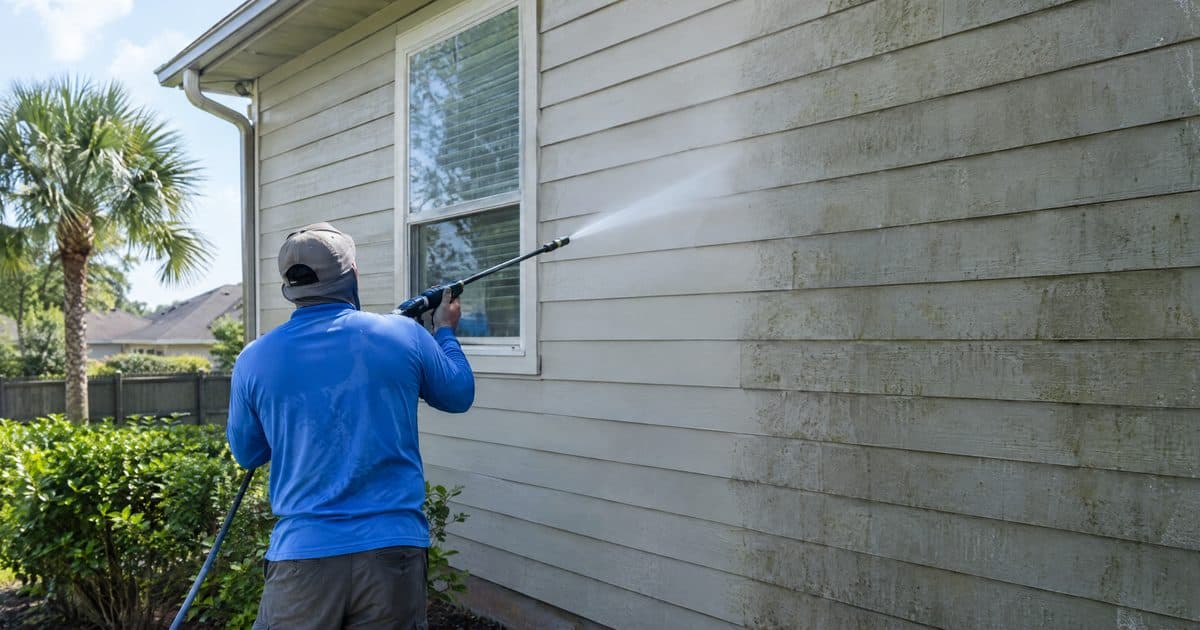
When a paint job fails early — peeling in a year or two, mildew showing through, cracks along the trim — the cause is almost always something that happened, or didn't happen, before the paint went on. Preparation is slow, unglamorous and invisible once the job is done, which is exactly why it is the step most often cut. Here is what it should involve.
Step 1: Wash
Every exterior repaint starts with cleaning the surfaces to be painted. Washing removes dirt, pollen, chalk from the old coating and mildew. Paint applied over any of these bonds to the contaminant rather than the wall.
Washing for paint uses controlled pressure and a suitable cleaner, with mildew treated where it grows. Too much pressure drives water behind siding and into window frames, and can gouge soft wood. The spray is aimed down the wall, not up into the laps of the siding.
Step 2: Let it dry
This is the step people underestimate in Houston. After washing, the siding and trim need to dry — not just on the surface, but in the wood. On a humid day, shaded walls can stay damp for a long time. Painting too soon traps moisture, and as the wood dries it pushes the new coat off.
Step 3: Scrape and sand
Loose, flaking and peeling paint is scraped off. Edges where old paint remains are sanded so they feather into the surface instead of telegraphing through the new coat. Glossy old coatings — common on older trim — are scuffed so the new paint can grip.
Not everything comes off. Paint that is still firmly bonded stays; removing sound paint takes time and gains nothing.
Step 4: Repair the wood
Wood rot is one of the most common findings on Houston houses. It concentrates where wood stays wet:
- the bottom courses of siding near sprinklers and flower beds,
- trim and fascia under gutters that overflow,
- window sills and the bottoms of door frames,
- anywhere caulk has failed and let water in.
Rotten boards are cut out and replaced before painting. Filler has its place on small, sound defects, but it is not a repair for rot. Larger siding replacement is its own job; see our siding and exterior repair service.
Step 5: Caulk
Joints between trim and siding, around windows and doors, and at corners are caulked with a paintable exterior sealant. Caulk keeps water out of the wall, which protects both the wood and the paint. Old, cracked caulk is cut out first; new caulk over old rarely holds.
Step 6: Prime
Primer goes on bare wood, new boards, repairs, stains and any surface the finish might not bond to. It is the layer that lets the topcoat grip. Choosing the right primer for each surface is covered in choosing exterior paint for Houston heat, humidity and mildew.
What to check before the first coat
If you want to see whether the preparation was done properly, walk the house before painting starts. You should find:
- walls clean, with no chalk coming off on your hand and no mildew left in shaded corners,
- loose paint gone and the edges of the remaining paint sanded smooth,
- rotten boards replaced, not filled over,
- fresh caulk at trim joints, corners, windows and doors,
- primer on bare wood, new boards and repairs.
It is far easier to fix a missed spot now than after two coats have gone on over it.
Step 7: Protect
Before any paint is opened, windows, light fixtures, the roof edge, plants, decks, walkways and the driveway are covered. Protection is part of the preparation, not an afterthought.
Older homes: when scraping is regulated
Many Houston houses were built before 1978, when lead-based paint was still used on homes. Federal rules — the EPA Renovation, Repair and Painting rule [U.S. Government Publishing Office, current eCFR] — apply to work that disturbs painted surfaces in those homes, and scraping and sanding are exactly that kind of work. The rule sets requirements for how the work is done, how the area is contained and cleaned up, and who may do it, and it requires that homeowners receive EPA's Renovate Right pamphlet before work begins [U.S. Environmental Protection Agency, current edition].
If your house was built before 1978, tell any contractor the year it was built before you talk about painting it.
Homes built before 1978: We currently quote exterior painting on homes built in 1978 or later. If your home was built before 1978, federal lead-safe rules (EPA RRP, 40 CFR 745) apply to any work that disturbs painted surfaces — tell us the year built and we'll talk you through your options first.
What this means for your estimate
Because preparation is most of the labor, it should be written out on your estimate as its own items, alongside repairs and painting. That is how we price: an in-person walk-through, then a written estimate. See our exterior painting page for the full process, read about Houston homes, or, for a house built in 1978 or later, ask for a painting quote.
Common questions
Thinking about your own house?
We walk the house in person and send a written estimate.