
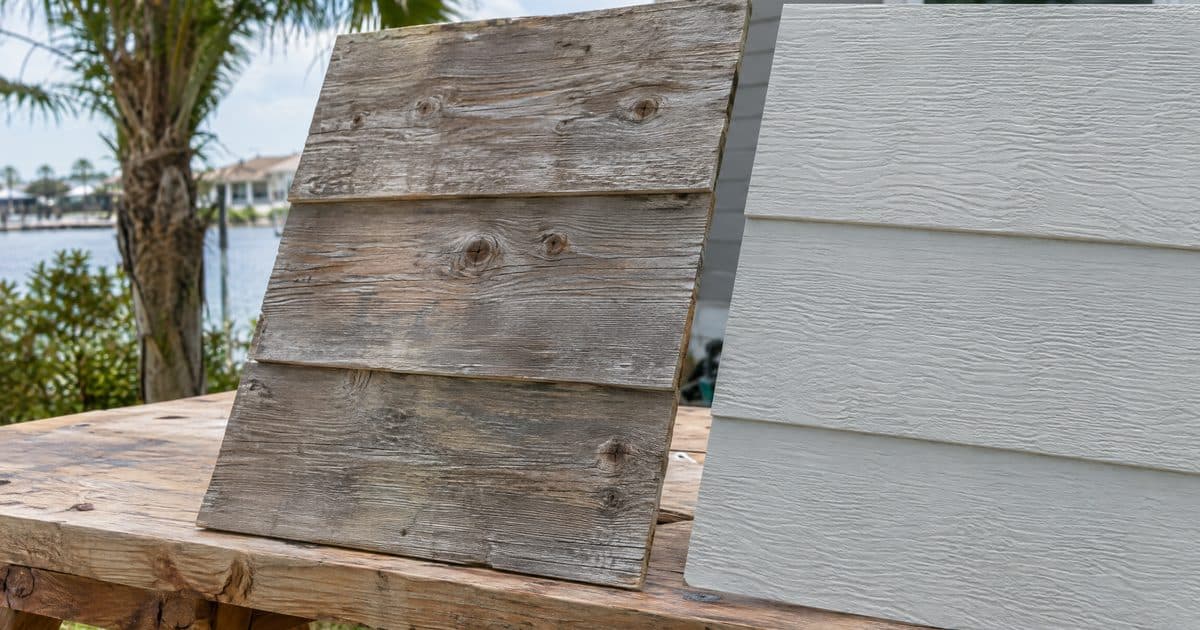
"Should I paint or replace my siding?" is often the wrong question, because most houses don't need one or the other everywhere. They need a few boards replaced where water has done damage, and a repaint of everything that is still sound. The skill is telling the two apart, and that means looking closely at each wall.
Wood siding
Wood lap siding is common on older Houston houses and on the sides and backs of brick-front homes. Wood moves with moisture and temperature, and it rots where it stays wet.
Signs a wood board can be painted: the paint is chalking, fading, cracking or peeling, but the wood underneath is firm when you press it, the board lies flat and is fastened tightly.
Signs a wood board needs replacing: a screwdriver sinks into it; the bottom edge is soft or crumbling; it has split along the grain and is curling; it has pulled away from the wall; or there is water staining on the inside wall behind it.
Rot concentrates low on the wall, near sprinklers and flower beds, under gutters that overflow, and around windows and doors where caulk has failed.
Fiber-cement siding
Fiber-cement is a mix of cement, sand and cellulose fibres, formed into boards and panels. It is dimensionally stable, doesn't rot the way wood does, and holds paint well — which makes it one of the easiest sidings to repaint.
It isn't indestructible. Look for cracked or chipped boards (often from impacts or from fasteners driven too hard), boards whose bottom edges have swollen where they sat in water, and failed caulk at butt joints and corners. Damaged boards are replaced; the rest is washed, spot-primed where needed and painted.
Panel siding and other materials
Some Houston houses have composite panel or hardboard siding, which can swell and soften when water gets into the edges. Swollen, soft panels need replacing; painting over them seals in a problem that keeps growing.
What partial replacement involves
Replacing damaged boards is ordinary work, not a whole-house project:
- Remove the damaged boards and inspect what is behind them — sheathing, house wrap, framing.
- Fix any damage behind the siding before closing it up.
- Install new boards matched in width and reveal to the existing siding. New fiber-cement is often used to replace rotten wood because it resists the moisture that caused the failure.
- Caulk the joints, then prime the new boards.
- Paint the whole elevation, so the repair disappears into the wall.
That last step is why siding repair and exterior painting are usually priced together. Our siding and exterior repair service handles the carpentry, and our exterior painting service handles the coating.
A quick check you can do yourself
You don't need special tools to get a first idea of your siding's condition. On a dry day, walk each side of the house and:
- Press a screwdriver gently into the bottom two or three boards, the corner boards and the trim around windows and doors. Firm wood is sound; wood that gives is not.
- Sight along each wall. Boards that bow, cup or step out of line may be loose or swollen.
- Look at the joints. Gaps where boards meet, or open caulk at corners, are where water gets in.
- Check inside. Water stains on interior walls, swollen baseboards or musty smells on an exterior wall can point to water behind the siding.
- Note where the problems cluster. If they are all near a sprinkler, a gutter or a flower bed, fixing the water source is part of the repair.
Write down what you find and where. It makes the walk-through with a contractor quicker and helps you compare estimates.
When full replacement makes sense
Full replacement is worth considering when damage is widespread across several walls, when the existing siding is a type that keeps failing in Houston's humidity, or when you are changing the look of the house anyway. It is a bigger decision, and it is worth getting an honest assessment of how much of the existing siding is really failing before you commit.
Painting after repairs
New boards need primer before paint. Fiber-cement often comes pre-primed; cut ends and nail holes still need attention. Wood replacement boards are primed on all faces where possible, so moisture can't get in from the back. Then the whole wall gets the same finish coats. We cover coating choices in choosing exterior paint for Houston heat, humidity and mildew and preparation in prep is the paint job.
Getting it assessed
We look at each wall on the walk-through, test the boards that look suspect, and send a written estimate with repairs and painting listed separately. Read about the Houston homes we work on, or ask for a painting quote.
Homes built before 1978: We currently quote exterior painting on homes built in 1978 or later. If your home was built before 1978, federal lead-safe rules (EPA RRP, 40 CFR 745) apply to any work that disturbs painted surfaces — tell us the year built and we'll talk you through your options first.
Common questions
Thinking about your own house?
We walk the house in person and send a written estimate.